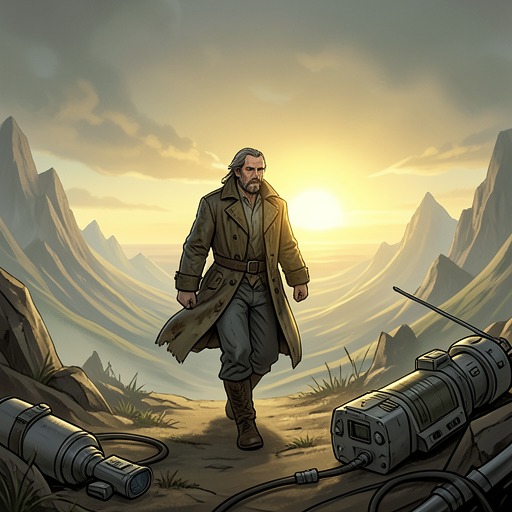
Expedition to Bright Defile
Chasing SunlightExpedition to Bright Defile is the decisive overland phase of Jonathan Heights’s search for Sunlight. After the Endeavor reaches the limit of safe travel, Jonathan establishes the ship as the line no vessel should cross and leads a reduced party east on foot. The expedition strips away the machinery and institutional protection of human civilization, placing Jonathan, Eleanor McAvey, Antomine, Captain Montgomery, six airmen, and their supplies on a silent road through the Grave of Wood toward the Bright Defile’s final revelation.
Causes and Background
The expedition grows out of Jonathan’s larger eastward quest. In a world defined by lightless skies and eternal darkness, he claims to have seen Sunlight and refuses to accept the prevailing belief that it is merely a myth. The journey is therefore not ordinary exploration or commercial travel: it is an attempt to reach the source of a revelation that Jonathan treats as both personal proof and an objective destination. The Endeavor carries agents with different loyalties and purposes, but Jonathan’s goal remains the organizing force of the expedition.
The route has already exposed the limits of human knowledge and control. Danby’s Point marks the eastern terminus of the illuminated human world, where a zint-lit tower stands against bruised-purple rock and human construction meets the architecture and peoples of darker territories. Beyond that boundary, human maps become contingent rather than authoritative. Tiuni’s intelligence about shifting forces, beasts, caravans, and the changing Verdant Expanse helps narrow possible routes, but it does not make the east predictable. Jonathan’s expedition depends on information gathered at the frontier while repeatedly confronting the fact that the frontier exceeds the systems meant to describe it.
The physical and political dangers encountered along the way reinforce this instability. The passage east includes the migration of the mountain-sized Glacilium, whose falling snow turns Beacon into a blizzard and carries Glaciwing predators with it; contact with the Caravaneers, whose knowledge and customs cannot be reduced to human expectations; and the aftermath of violence and corruption at places such as Danner’s Grasp. Even when Jonathan refuses Antomine’s demand to cleanse Angkor Leng of Umbraught, their argument exposes the expedition’s central conflict: Antomine understands civilization as a responsibility to those who come later, while Jonathan measures every action against the single purpose of reaching Sunlight.
The Decision to Proceed on Foot
The immediate transition occurs when the party encounters the Discovery and recognizes the danger of sending the Endeavor farther. Jonathan proposes that the ship itself go no farther, declaring the location a boundary beyond which no ship should pass. He argues that proceeding on foot will be faster than waiting for the Endeavor and assumes responsibility for the final approach. The decision is practical, but it is also symbolic: the vessel that made the expedition possible becomes an object left behind at the edge of the unknown.
The detachment is notably small. It consists of Jonathan, Eleanor McAvey, Antomine, Captain Montgomery, and six airmen, including Airman Stutt and the brawny and wiry pair among the crew. Most of the remaining airmen choose to stay aboard the Endeavor, where repairs still require attention and the approach to Sunlight appears too dangerous to justify further risk. Jonathan finds their reluctance difficult to understand, but it serves his purpose by leaving him with a manageable group rather than a reluctant army.
The expedition thus enters its final stage through a mixture of necessity and selection. Jonathan’s confidence contrasts with the crew’s caution, while the presence of Eleanor and Antomine ensures that the journey remains politically and morally contested rather than becoming a solitary pilgrimage. Captain Montgomery supplies command experience and practical support, but Jonathan remains the figure oriented toward the destination, treating every delay and diversion as subordinate to the approach.
The Road Through the Grave of Wood
Jonathan knows that the Bright Defile lies no more than a day’s brisk walk to the east. The party has a sled carrying supplies, yet he does not expect to need much of it. The Grave of Wood is unusually quiet, without creatures or weather to trouble travelers. Its road is made of long metal flagstones, bordered by the looming forms of salt bodies and wooden biers. The setting transforms the final approach into a passage through a landscape structured by the dead.
The group chooses the road because it leads somewhere. When Eleanor questions why Jonathan would take this route after the loss of the Discovery, he explains that a path is preferable to becoming lost among monuments or wilderness and might lead to something useful. His answer reveals the expedition’s characteristic logic: even in a place of death and uncertainty, movement is justified by the possibility of discovery. The road is not safe because it is familiar; it is useful because it provides direction.
The silence of the Grave of Wood also changes the expedition’s tempo. Earlier stages are marked by airships, storms, battles, markets, alien settlements, and competing claims over resources. Here, the party moves along an empty thoroughfare under lantern-light. Eleanor and Antomine exchange remarks, Captain Montgomery speaks with his men, and Jonathan keeps his attention fixed ahead. He eats hard bread and dried meat despite having little appetite, forcing himself to maintain his strength for the final stretch.
The Threshold and the Revelation
Jonathan’s mood reveals how completely the journey has narrowed around its goal. Eleanor notices that he seems unnaturally happy after remaining serious for so long, while Antomine studies him without comment. Jonathan explains that he is looking forward to the culmination of the journey, though the controlled expression he adopts cannot conceal the intensity of his expectation. He does not know when the destination will appear, and that uncertainty makes him unwilling to look away.
The moment arrives as Captain Montgomery begins considering whether the party should stop for the night. The dark path continues straight and eastward, and then Sunlight appears. The expedition’s central value shifts instantly from pursuit to revelation. Sunlight is not presented as a distant lamp or an object that requires interpretation. To look upon it is to understand it immediately and intimately; its nature carries an irrefutable revelation that makes the world visible for the first time.
This ending fulfills Jonathan’s stated purpose while also making the expedition more than a successful geographic journey. The final crossing is epistemic as well as physical. The party has traveled from the illuminated but partial order of Beacon, through frontier exchanges and nonhuman territories, into a darkness that human knowledge cannot master. At Bright Defile, visibility itself becomes knowledge, and the destination changes the meaning of every earlier map, warning, sacrifice, and argument.
Consequences and Narrative Significance
The overland expedition completes the transition from organized exploration to threshold experience. The Endeavor remains behind, the crew divides between those willing to proceed and those who remain with the damaged ship, and the final party enters the Grave of Wood as a temporary community defined by a common risk rather than a common purpose. The journey’s structure resembles a quest, but it also reverses the usual promise of safe return: the closer Jonathan comes to Sunlight, the less relevant the institutions, technologies, and assumptions that sustained the expedition become.
The expedition’s significance is sharpened by the broader consequences of the eastern voyage. After the Endeavor’s return, the combined disturbances associated with the expedition produce the period some people call the Winter of Blood, while others mockingly call it the Winter of the Shadow. Beacon experiences unusual excitement, the surviving airmen become wealthy from their shares and from the sale of artifacts connected with the destruction of Tor Ilek, and some leave the air service or acquire their own airship. Yet the city absorbs these consequences as gossip and commerce rather than as a transformation of its understanding. By the time Captain Montgomery outfits the Endeavor for another expedition, the new departure is treated as an ordinary undertaking.
That contrast gives Expedition to Bright Defile its final irony. For Jonathan and the detachment, the eastward walk culminates in the first true visibility of the world; for Beacon, the expedition is eventually folded into wealth, rumor, and another departure. The path to Bright Defile therefore marks both an arrival and a separation: Jonathan reaches the truth he pursued, while the society that sent ships into darkness remains capable of treating the consequences as merely another season of adventure.